Scandinavia 15 neutrality


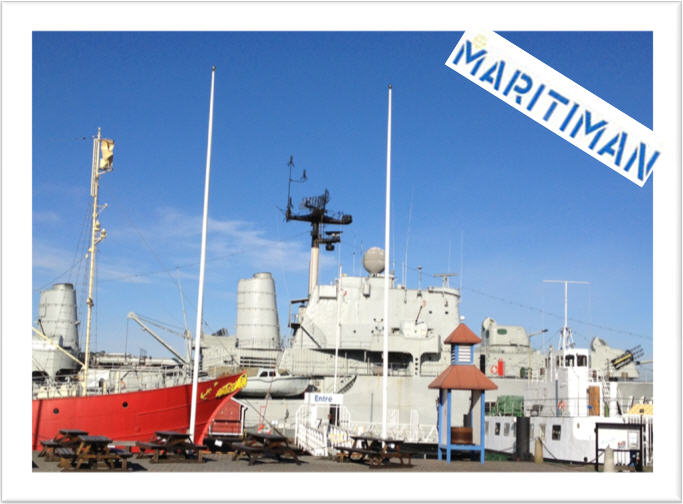
In WW II Sweden was as neutral as a nation could be located next door to Nazi Germany and beside Norway — which the Germans occupied in a surprise attack early in the war. My impression was that Swedes regard their WW II “neutrality” as an embarrassment, and in reaction are making “neutrality” a positive. More power to them. Of course, as I realized later, our discussions were taking place on the deck of a retired destroyer that had aggressively represented Sweden’s sovereignty during the Cold War.) By the way, the destroyer was pretty heavily armed--both 53 and 57mm guns, anti-aircraft guns, torpedoes, mines, and cruise missiles!
We also toured a light ship (Like a lighthouse). The sub was smaller than other subs I have toured, and it had a good, simple video about ballast and maintaining trim and neutral buoyancy. They also had a “monitor” (like the Monitor from our Civil war), although it was basically an empty hull. The compartments were labeled as cabins, storage, galley, etc., but there was nothing in them, not even an engine.
(to be continued)

Scandinavia 14 Maritiman


Breakfast at the hotel offered good variety—egg, meats, cheeses, breads, and Swedish pancakes! By the way, Göteborg is pronounced yur-te-borry!
The only real plan I had for today was Maritiman, a collection of ships you can explore, including a Swedish destroyer, a submarine, and a freighter. Well, that was enough! I think we spent about 4 hours there!
We were poking around the destroyer, reading signs, when a young woman guide offered to help. We spent a couple of hours (!) talking with her. She has one year to go to finish her bachelor’s degree. She is just learning about the ships, especially English nautical terms, but she knows some Swedish history, and we had a good discussion. (L note: Her take on Sweden is that Swedes have embraced “neutrality” as their defining characteristic. They work, play, and befriend one another for what they are — not what they demand, or require, or even want the other person to be. 
 “Neutrality” is a good explanation for the Pride parade and the accompanying enthusiasm. Of course I asked about WW II and Sweden’s “neutral” role, which I had just learned about while in Norway.
(to be continued)

Cranky Old Hag in Scandinavia 13 LGBTQ


It continued for another hour—I think every group in the city participated—political parties, social clubs, you name it. You know how every one is Irish on St. Patrick’s Day? Well, everyone was showing solidarity with the LGBTQ (only here it seems to be HBTQ, I think) community. There were clubs, families, gay couples, hetero couples, children, drag queens, bands, Brazilian Carnival groups, African groups, Amnesty International, socialists, communists, Liberals, what looked like scout groups, a group from the police(!), and on and on. Surprisingly, we didn’t see any opposition. No backlash. Just a lot of people having fun, with some good music and good cheer. There was also a party/concert at the end, which we didn’t stay for (speeches in Swedish). We later found out it was the last day of a 5-day festival. Talk about serendipity!
When the parade was over we walked back to the hotel (through the city park) and checked in. It was Sunday evening, so most places were closed. We did discover that there seems to be no place nearby to do laundry. “We don’t do that in Sweden.” (You don’t do laundry?) We could put some items in a bag for the hotel to have cleaned for us. I was hoping to do a week’s worth of laundry. So I washed out a few things in the sink. That should keep us respectable as far as Copenhagen, at least.
(to be continued)

Scandinavia 12 Göteborg

  Found our hotel okay, dropped off our luggage (too early to check in), and headed for a boat tour of town. Interesting walk through town—old buildings and squares. The boat tour was excellent! (What we wanted in Stockholm, and didn’t get.) We were on a canal boat with a live narrator, who did the whole tour in English because everyone was comfortable with that. There were many very low bridges.
  We also went out into the harbor and saw the shipyards that flourished after WWII and have since all closed (the last one in 2014). She told us some about the history of the city and showed us some of the remaining walls of the city. The boat was open air so pictures were possible, and the motor was quiet so we could hear the guide.
After the tour, we got lunch at a Spanish restaurant nearby, then decided to walk back toward the hotel through a canal-side park.
  But, what was this? Police closing a street? What is happening? A festival, a parade, a “pride parade.” We have just attended our first gay pride parade. There were a lot of people lining the streets to watch, so we joined them. People marched past us for 30 minutes—a lot of people, many waving rainbow flags, some dressed to shock, most pretty ordinary. So we went to sit down for a while, when we realized the parade was not over—there was just a gap.
(to be continued)

Scandinavia 11 Aquaria water museum

  After a few hours there, we moved on to the Aquaria water museum, which was small, but had some interesting fish. The “ocean” tank had some small rays and sharks, and colorful tropical fish, crayfish, anemones, and corals. They had a seahorse exhibit, and they breed “salmon trout.” The rainforest exhibit had a very large peculiar-looking fish (not identified) and a couple of fresh-water rays with round disc-shaped bodies.
There were a lot of people waiting for the return ferry, and it took a while to get on, but the ferry itself was not crowded. This was the day and about the time of the wedding of the prince (his older sister Victoria is the heir). So some streets were blocked off, and there were police around. Back in Gamla Stan, we returned to the cafe where we ate the day before. Larry got lasagna, and I had a salmon and spinach quiche. Both were good, but neither of us were able to finish.
 We walked back through Gamla Stan and along the waterfront to our hotel, and collapsed for a couple of hours, then packed for an early departure.
Got up at 6:30 and left the hotel shortly after 7. Too early for breakfast at the hotel, but our train was at 8:22. We walked the 2 km from the hotel to the train station. Along the way, police on motorcycles blocked a couple of intersections, and we saw a short motorcade coming from the directions of the castle. Other than police cars, there were 3 matching (!) cars and one other in the motorcade.
Got to the station before 8 and bought muffins and coffee for breakfast on the train. Southern Sweden seems to be forest and fields, with an occasional small town thrown in. We did see a deer running through one of the fields. Our train trip was blessedly uneventful this time.
(to be continued)

Scandinavia 10 Djurgården island

Saturday, June 13
We walked to the ferry to Djurgården island. Stockholm is built on an archipelago, with lots of islands. Supposedly there are locks separating a lake from the Baltic, but I don't know where that is. We did see some fairly large cruise ships in Stockholm, but no freighters. The ferry was packed—standing room only, and I think we were the last ones on (also the last off—they unloaded from the other end). Djurgården has several museums, an amusement park, and a LARGE park with green space. The ferry dock is right next to the amusement park.
   We walked to the Vasa museum, which houses the Vasa, a large warship completed in 1628, and which sank intact within 30 minutes of launching. It was raised in 1961 and has been preserved 98% original. It had 2 gun decks and lots of elaborate carvings. Unfortunately, it was a bit top-heavy and bottom-light, so a cross-wind did it in. This was all during the 30 Years War in northern Europe, so we learned a little about that,too.

(to be continued)

Cranky Old Hag in Scandinavia 9 Tre Kronor

Then we went to Museum Tre Kronor, which means Three Crowns Museum, and which was in the basement of the Palace. It contained a lot of history of the palace, and areas that used to be the foundations, exterior walls, a kitchen with a hearth and a well that had been excavated under the present palace, etc. The palace was begun in the 1200s and grew through the 1600s, when it burned and had to be rebuilt. So we have seen another medieval castle/palace on this trip! Many of the rooms we saw had barrel vaults, and we saw places where the defenders climbed up the inside of the exterior walls to shoot crossbows at attackers. What was the top of the exterior wall is now in the basement!
  Following this, we decided to look for a place to eat in Gamla Stan, and we found a small cafe that sold sandwiches and baked goods. Larry got a roast beef sandwich on a really good small loaf of bread, and I got an open-faced sandwich with shrimp, hard-boiled eggs, mayo, and arugula. We split a piece of chocolate cake for dessert. Very cool cafe.
Thus fortified, we walked back to our hotel. We found a route that did not involve any steep hills and just enjoyed the sun and the water and the scenery.
(to be continued)